
80% decrease in school shootings
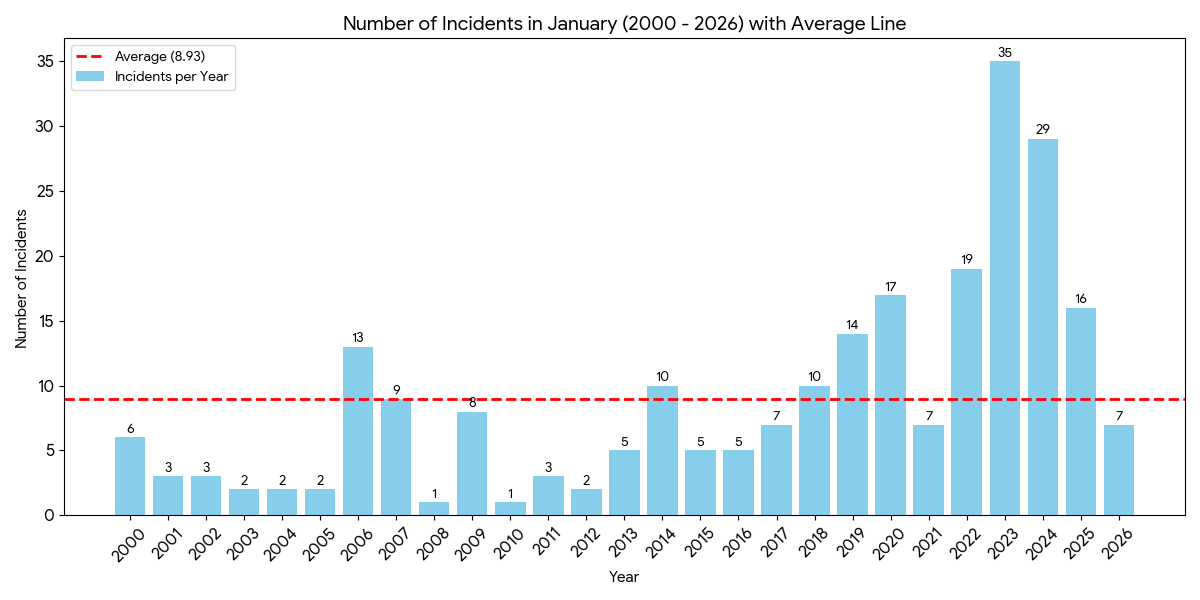
January 2026 was the first month below the 25-year monthly average for shootings on k-12 school property since 2017.

I started recording every shooting on k-12 school property in February 2018. The start of this year is the first month since 2017 (excluding the COVID lockdowns in January 2021 when most schools were closed) when the number of shootings fell below the 25-year average for the month of January.
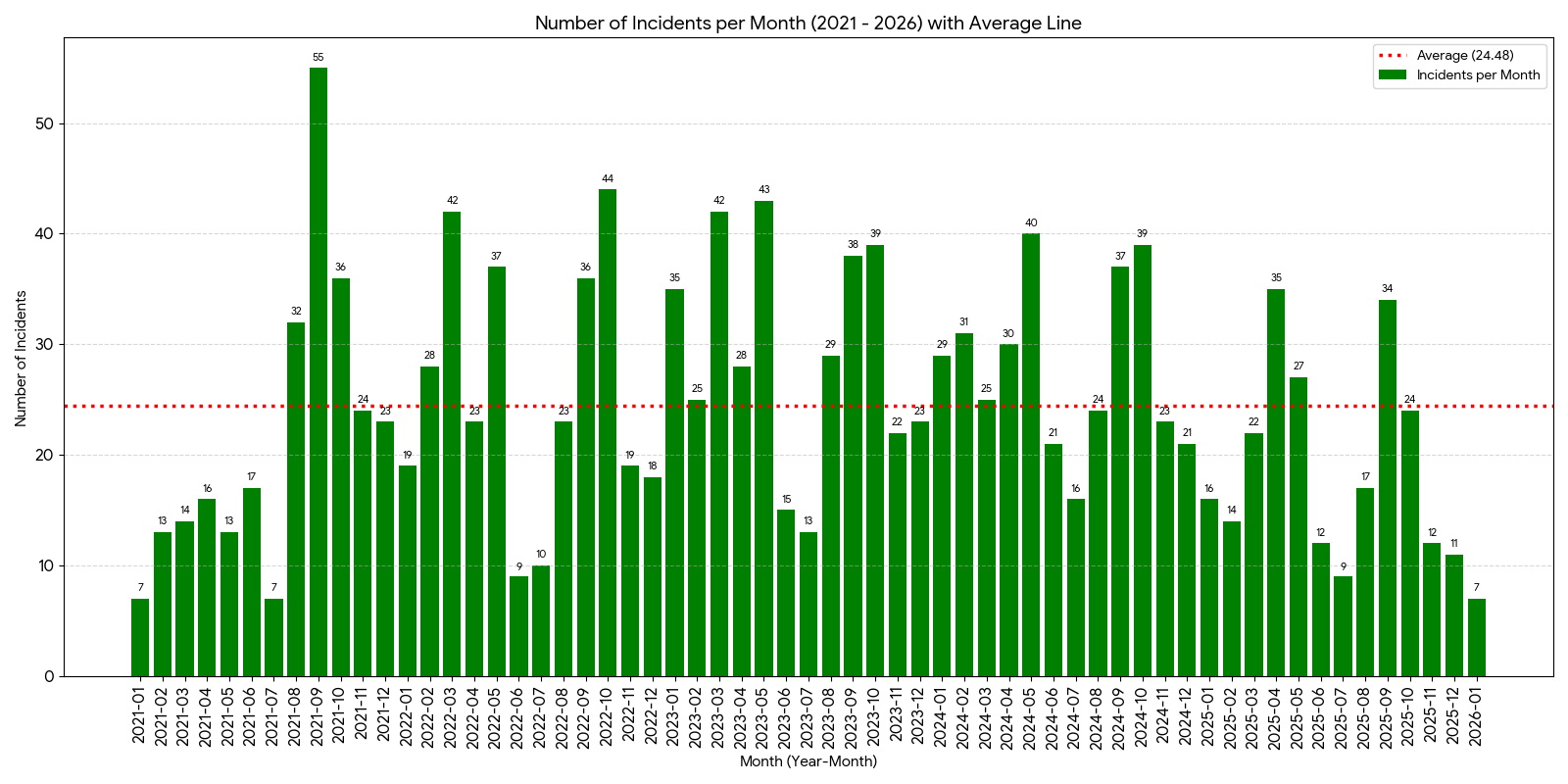
Between January 2021 and January 2026, there was an average of 24.5 shootings on campus per month. January 2026 ties for the lowest monthly total across this entire five-year period.
While the number are way down and trending in the right direction, it’s not all good news. Here are the seven shootings that happened at schools in January 2026:
Two students were fatally shot at the bus stop in front of the school during dismissal (WA)
Student was fatally shot by a teammate who was playing with a gun before high school soccer practice (TX)
Police officer was fatally shot by military security guards at a Marine base elementary school (NC)
Student was wounded when 30 shots were fired during a fight outside a high school basketball game (AL)
Student’s father fired 7 shots and tried to break a window when he was denied entry into the school to pick up his child (MI)
3rd grader shot the window of his school bus (AL)
Bullets struck the walls and window of the school during morning classes (IL)
As you can see from these seven shootings, there is still crazy stuff happening at schools that is traumatic for everyone involved. Four people (3 students and a police officer) died on k-12 school campuses from gunshot wounds during school hours in January. There is just 80% less than the peak in 2023.
Looking more broadly at the total number of incidents per year, 2026 is on pace to be the lowest total since 2017.
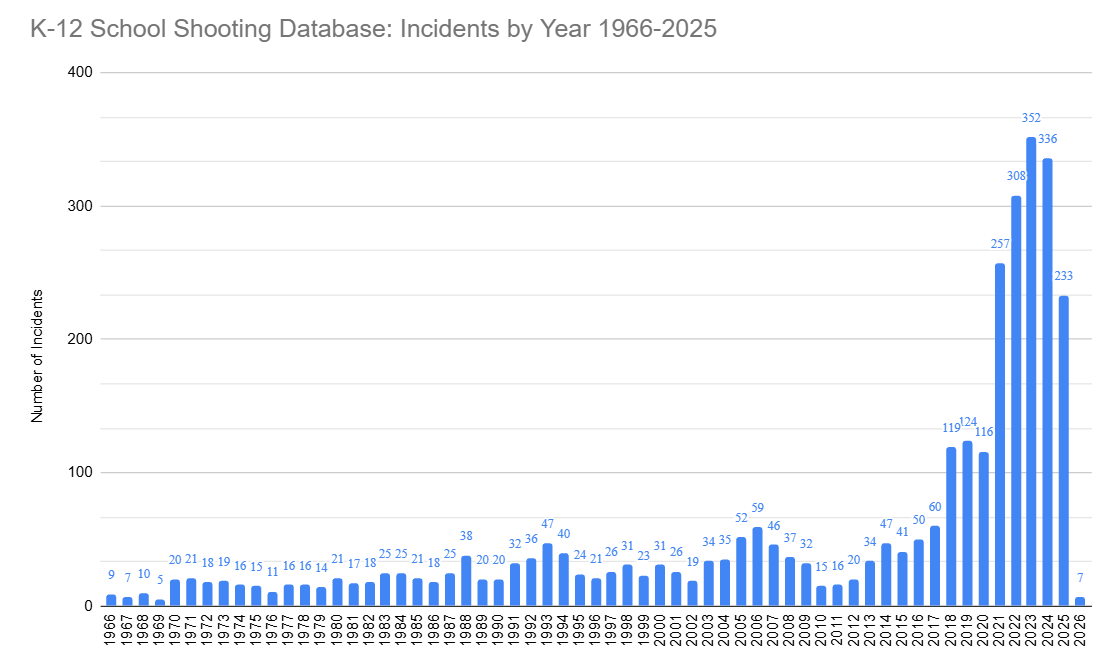
What changed since the increases in 2018 and the post-COVID systemic gun violence surge with multiple disputes turning into shootings on campus every week?
First Peak in 2018
In the spring of 2018, there we three planned attacks at schools with 20+ victims in Marshall County, KY, Parkland, FL, and Santa Fe, TX. That same spring, there were also:
A planned attack stopped by a teacher in Noblesville, IL
A planned attack stopped after the first 10 shots in Palmdale, CA
An attempted mass shooting by a student who had a rifle inside a guitar case in Ocala, FL
A student planned a mass shooting and then fatally shot himself inside a school bathroom instead of committing the attack in Massillon, OH
A student attempted to commit a mass shooting during graduation rehearsal and was stopped by a school police officer in Dixon, IL
A teacher with a gun barricaded inside a classroom in Dalton, GA
I’ve studied the shootings on campus every year since 1966 and there is no other period of pre-planned mass violence at schools that parallels the spring of 2018.

When 2018 was an abnormally high year for planned attacks and post-COVID was an abnormally high period for disputes, why is January 2026 so low? My only answer is that I don’t really know.
The two peaks came during the highest period of focus and investment into school security. This decline in shootings started just as the post-Parkland and then post-Uvalde surges of federal grant funding and multi-year service contracts for security products are ending. School shootings follow the Issue Attention Cycle pattern and we are seeing this significant decrease as public interest in the issue has declined.
What stops school shootings?
Based on my newly published journal article, certain laws are more consistently associated with reductions in school shooting incidence than others. If you look back at the three mass casualty attacks and six near misses in the spring of 2018, 6 of the 9 school shootings took place in states with minimal firearms legislation.
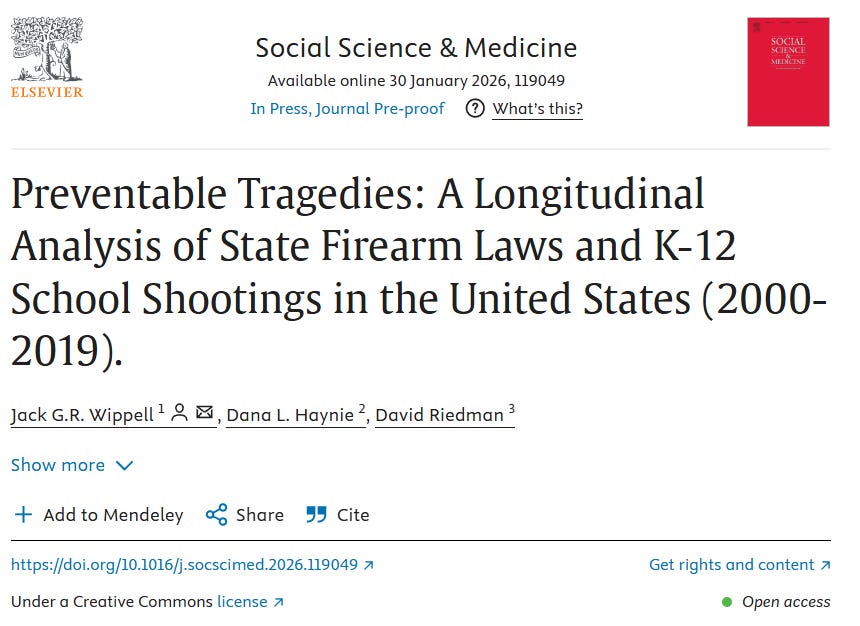
We found the strongest state-level predictors of reduced school shooting rates are:
assault weapon bans
permit requirements
prohibitions on firearms on elementary school campuses
criminal liability statutes for negligent storage
Our results suggest that the extremely permissive firearms laws in certain U.S. states may contribute to a higher rate of shootings on k-12 school campuses. Our findings broadly suggest that state firearm legislation can function as a structural determinant of child and adolescent firearm risk. This supports moving beyond individual risk factors (e.g., red flag laws, background checks, threat assessment model) to a more systematic, policy-based approach for reducing gun injuries and deaths.
David Riedman, PhD is the creator of the K-12 School Shooting Database, Chief Data Officer at a global risk management firm, and a tenure-track professor. Listen to my podcast—Riedman Report: Risk, AI, Education & Security—or my recent interviews on Freakonomics Radio and the New England Journal of Medicine.