Massachusetts Democrats ought to be ashamed.

🔗 Inside ICE’s Only Contract with a Blue State | Bolts:

Massachusetts is the only state that voted against Donald Trump in 2024, and where the governor is a Democrat, where a state agency is contracting with the 287(g) program. It’s also the only state where Democrats fully control the state government that has such an agreement.

Virginia shared the distinction until last week, when new Democratic Governor Abigail Spanberger announced she is withdrawing Virginia state agencies, including the state’s DOC, from the 287(g) contracts she inherited from her Republican predecessor, Glenn Youngkin.

Massachusetts Governor Maura Healey, a Democrat, also has the authority to decide if her state’s DOC remains in the ICE program. She has defended and preserved the 287(g) agreement, even as she otherwise seeks to limit ICE activity in the state. Her office has not responded to my repeated calls and emails about the state’s participation in the program.

This is a fucking embarrassment, and it is a pretty searing indictment the Democratic establishment here in Massachusetts.

I have asked repeatedly where Gov. Healey is in any of the blue-state pushback against the Trump regime. The answer seems to be nowhere, and the Democratic leadership in the state legislature is equally useless. They can barely move bills through the legislateive process, much less lead any sort of out-front effort to protect residents from the feds.

I’m not looking for high-profile stage-grabbing antics. I don’t really want my governor out there on the national stage, exchanging snarky tweets with fascists. I want them doing real policy and governance here at home that helps and protects residents of the Commonwealth.

And I want a state legislature that will actually take up and pass meaningful legislation that will move us forward.

Instead, all branches of the state government seem to be controlled by party fixtures who have made their way up through the ranks and are now content to settle in for the ride. And I guess if that means handing folks over to the Trump regime’s goons rather than rocking the boat, then they’re happy to do that.


AI boosterism as a heuristic for identifying fools

I am reading Paul Ford’s op-ed in The New York Times about how much fun he’s having using LLMs to solve basic software development problems, and all I can think is that it really is a sign of the times that an otherwise smart person could write and publish a piece like this in the biggest, most important journalism platform in the country and feel good about it.

I am not going to link to the op-ed, because I don’t know want to reward either Ford or the Times with the traffic, and also because these essays seem to be a dime a dozen these days.

You know the drill. Someone has the usual concerns about AI and LLMs: the environmental impacts, the intellectual property issues, the job losses. But darn it, it’s just so cool playing around with these tools. They built a whole website in a day! It analyzed that spreadsheet in a few minutes and turned it into a database! It made a to-do app that works just like they’ve always wanted!

I have read and enjoyed a lot of Ford’s writing and commentary in the past, but this piece is just garden-variety AI apologism. Sure, the use cases he describes in the piece are fast and cheap, but only if you ignore the massive external costs. Like everyone boosting this stuff, he has to either ignore those costs, or wave them off with speculation about how neverending advances in the technology will balance them out. The latter tactic is not far off from the “But just wait until it cures cancer and solves climate change!” hand-waving we get from the charlatans running the AI companies and from their lackies and lickspittles on LinkedIn.

What I am finding is that the real purpose these sorts of op-eds and posts serve is to identify people that I no longer need to listen to. Maybe you had some good insights and a helpful way of looking at technology and our interactions with it in the past, but either your brain has been cooked or you have decided to try to jumping on the gravy train before it goes off the rails.

Either way, I no longer trust your judgement.


Quitting bad books

A general rule I have set for myself concerning novels is to give any new one that I have started one hundred pages before I decide whether to keep reading or to give up. Some books pull me in immediately, but with most, it takes a while for me to get into the groove of the story and the characters. One hundred pages is usually far enough in for me to have gotten engaged, but not so much as to make me feel like I have over-invested in a novel I don’t like.


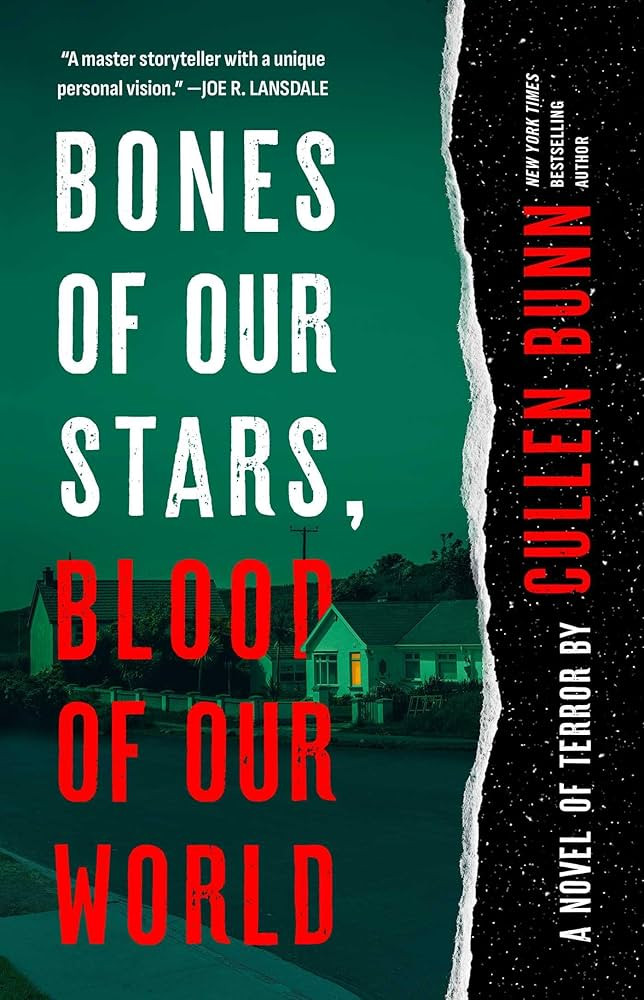
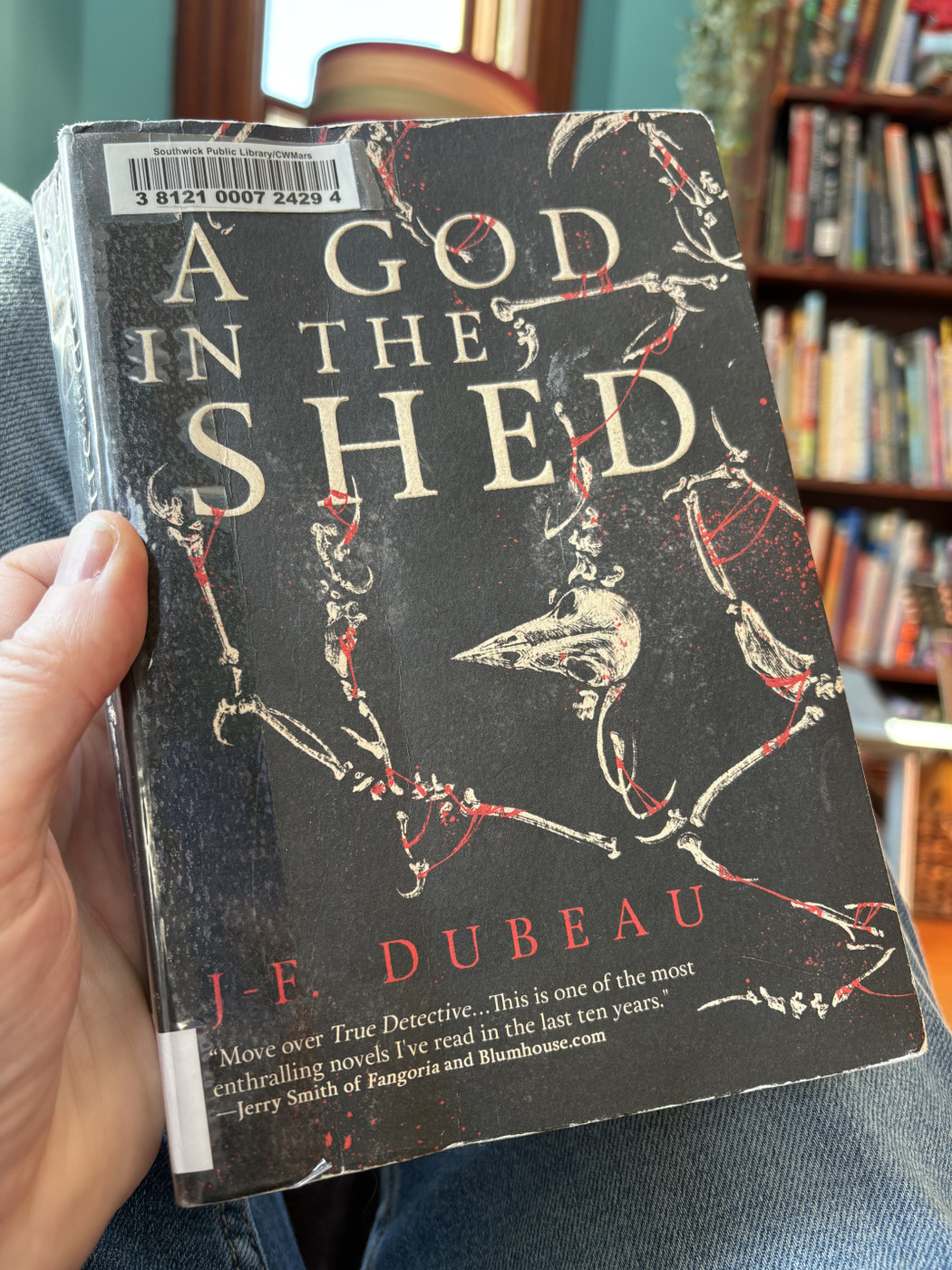
All of which is by way of preface for this books A God In the Shed by J-F. DuBuea. I have it out from the library after it showed up in the recommendations after I had finished Cullen Bunn’s Bones Of Our Stars, Blood Of Our World a couple of weeks ago. I really liked that book, and was in the mood for something similar, so I decided to give this one a try.

It’s not great.

I only made it about sixty pages—thus violating my 100-page rule—but it was quite clear by then that it was not going to be worth finishing. With a multi-character story set in a small town beset by some sort of ancient, occult horror, this book should have been right up my alley, so I don’t feel like this falls into the “It’s not for me” category.

Books that fall into the “It’s not for me category” are those where I find I can’t relate to the characters and their stories; they are books that are well-constructed but which I just do not find to be all that interesting. The problem with this book is that it is poorly written.

I was suspicious from the start due to the naming of each chapter by the POV character. I think I have complained about this trope before, but I find it to be a pretty good indicator of an author who either lacks confidence in their own writing or who doesn’t know what they’re doing. You shouldn’t need to put a big name at the start of the chapter to tell the reader which character they’re with; they should be able to figure that out on their own from the story.

The problems multiply from there. ClichĂ©d characters, clunky cultural references, and poorly constructed narratives are a small sampling of the issues. The details don’t really matter; they are kind of beside the point, which is that this book was the first thing I have read in a while that clarified the border between the bad writing and “not for me” books, and I found that to be helpful and reassuring.


Making financial aid application mandatory is a dumb idea and the wrong way to think about the problem.

🔗 Applying for financial aid should be a Massachusetts high school graduation requirement:

Making FAFSA completion a graduation requirement in Massachusetts isn’t about mandating college. It’s about keeping every door open. It’s about removing barriers, expanding opportunities, and making sure every high school student graduates with the necessary resources to follow their dreams, whether it’s postsecondary education, enrolling in military or other service, or entering directly into the workforce.

Yeah, let’s pile even more responsibility and burden on students and the under-resourced schools that they attend. I’m sure that will work out great!

Alternately, we could—oh, I don’t know—maybe just give the money to people who need it instead of burying it behind obscure application and means-testing mechanisms. Or, CRAZY THOUGHT HERE, make post-high school education more affordable and stop forcing people to jump through all these hoops to gain access to it.


🔗 Bitcoin Is Crashing So Hard That Miners Are Unplugging Their Equipment:

Instead of mining crypto, companies are starting to pivot, according to Bloomberg, allocating their hardware to powering AI models instead of mining crypto.

Because of course they are.

This entire economy is like Gromit frantically laying down the track in front of the train as it speeds along. 

I feel bad using that analogy because Gromit has always seemed imminently sensible and I don’t think he would have anything to do with any of this nonsense.


Outsourcing the core of your business seems like a bad idea.

🔗 The AI Free Lunch is Over - by Bryan Ross:

Subscription tiers have proliferated and token limits have become a real constraint. Premium pricing for complex reasoning has emerged as its own category, with extended thinking modes and deep research capabilities commanding higher rates. Users are hitting Claude Code limits mid-session, finding that agentic features burn through allocations faster than anyone anticipated.

What makes this particularly challenging is the unpredictability. Unlike traditional infrastructure costs that scale somewhat linearly, AI spending follows the complexity of the task. A minor change in prompt structure can double inference costs overnight. An agentic workflow that tests well in development can blow through production budgets in hours.

And dollars to donuts, Anthropic and OpenAI and their ilk are feverishly working on the darkest of dark patterns to keep users engaged and on the hook. Plenty of people have made the slot machine analogy and that is exactly right.

Among the many aspects of this current AI mania that continue to amaze and depress me is that all the people bought in and pushing it seem to have no time at all for concerns about what any of this means in the long term. There is no way any of this is sustainable. Of course it’s not sustainable environmentally, but I’m not even talking about that here.

I get why the people building these products are taking this approach; their fortunes depend upon no one asking too many questions about Phase 2. They don’t care because this scam is making them money now and worrying about what happens next is for suckes.

No, what I’m talking about here is all the businesses that are throwing their lot in with this scam. How, as a responsible leader, do you look at a sketchy tech product that has no sustainable business model and is being pushed by people with long, unbroken strings of failed promises and think to yourself “I want to build this thing into my core internal processes and value chain and be completely dependent on companies who will happily degrade the service and crank up the costs at the drop of a hat”?

The frightening and depressing answer—I suspect—is that none of these company leaders is responsible, and they are all just as focused on the near-term rewards (to the exclusion of any sort of sustainability) as the AI companies.


The one big question that Star Trek keeps failing to answer

Update: I guess I have to start watching Starfleet Academy now.  

While I have found the majority of the Paramount+ era Star Trek output to be rather disappointing, I don’t think any of it is bad or like it has betrayed the Star Trek legacy or any of that bullshit that the worst people on the internet get themselves all worked up over. I appreciate the shows’ diversity in casting, and I like that they have been willing to try some new and different stuff.

The main problem I have with basically every Star Trek offering of the last, oh, twenty-five years is that it has all systematically failed to answer the most important question hanging over the entire franchise.

That question is, of course, “When will Sisko return?”

While I do like Star Trek and have watched just about all of it over the decades, I will never forgive the franchise for leaving Deep Space Nine—the best series they’ve done—out in the cold. There have been like twenty different times where any number of storylines could have been made more interesting by the return of the Emissary, but instead we get a bunch of retreads of TOS and TNG. Those were both good shows, but I feel like they have had plenty of time in the spotlight.


Bones Of Our Stars, Blood Of Our World by Cullen Bunn


I finished reading Cullen Bunn’s new book Bones Of Our Stars, Blood Of Our World last night. It is first adult novel, so having really enjoyed his Harrow County series, I was pretty excited to start this one.

The book starts out as serial killer hunt with a bit of small-town horror thrown in, but as the story unfolds, it starts to hint at much more epic goings on. I could recognize what seemed to be bits and piece of other stories I had read here, but nothing too obvious or egregious.

The characters are well constructed (which is impressive, given how many of them there are), and Bunn does a good job of keeping the story rolling as he switches around between the various points of view. I never lost track of who was who or what they had been up to the last time we saw them.

The body count in this book is high. Very high. Not to give too much away, but I wouldn’t get too attached to any particular characters. It also drags ever so slightly in the final act; that’s when the previously narrow scope of the serial killer story explodes into something much larger, and I found that the scenes of epic mayhem were going on a bit long and started to feel a bit repetitive.

Overall, though, I really enjoyed this book. It had that Stephen King thing where I kept wanting to read just one more chapter, and I find myself kind of bummed now that I am done with it. If you’re looking for a good horror novel that cooks along, this one fits the bill. I hope Bunn keeps at it with the novels, too; his comics and graphic novels are great, but he’s clearly got the storytelling chops to dig into some meatier stuff.


Some things I did this morning

Canceled Amazon Prime

I should have done this a long time ago, but for no reason other than (sadly) laziness, I hadn’t. We order almost nothing from Amazon at this point and use none of other crap that comes with a Prime subscription.

My wife texted me this morning “What would you think about canceling Amazon Prime?” to which I responded “I was literally just thinking about doing that two days ago.”

Now it’s done, so I figured why not keep going?

Killed off my AWS account

I moved all of my stuff off of AWS over a year (maybe two) ago, mostly by shutting things down, but also a bit of migration. Did I really need all of those backups sitting in S3 buckets? Nope. I had also killed off all of my EC2 and Lightsail instances; when I experiment with new stuff these days, I mostly do it locally on my Raspberry Pi.

Even so, I still had my AWS account, and have kept getting a $1.02 bill each month. Turns out it was two snapshot I had missed, which turned up when I close my account.

Amazon Chase card

I still had this stupid credit card sitting around from back when we used to order a lot of stuff from Amazon. I never use it anymore, but had not gotten around to getting rid of it always felt like more than I wanted to take on.

Canceling the card turned out to be easier than I thought it would be. Of course there’s no button on their website or in their mobile app to cancel your card and close your account, but I sent the request via their “Secure Messaging” 🙄 tool saying close my card, don’t try to upsell me or offer me deals to get me to stay, just cancel it because Amazon sucks and Bezos supports the Trump regime.

Thirty minutes later, I got a response saying my request had been processed and that my card and account had been closed.


Who cares?

I’m one person, and my business doesn’t even amount to a drop in the bucket for Amazon. On top of that, I had barely been using any of their service for well over a year, so do any of these steps even matter? Probably not.

There is also the question of whether I have even actually moved off of Amazon. Dollars to donuts, if I started poking around at all the various apps and services I still use, their underpinnings probalby have some AWS dependencies. It is pretty hard to escape.

Still, I guess my point in sharing any of this—aside from just feeling good about myself for finally having done any of this—is to suggest 1) it is not super difficult to start extracting our lives from some of these companies, 2) we don’t have to do it all at once, and 3) every little bit counts.


The creative writing curriculum at Starfleet Academy is apparently not great.

I watched the first 10ish minutes of this new Star Fleet Academy series, and that was as far as I could get before turning it off.

I wish that shows would have a bit of confidence in their audience and not feel like they have to spend the first chunk of the premier dumping a ton of super-obvious expository dialog on them where they explain all of the characters and their backstories and motivations via conversations no real person would ever have.

It is undoubtedly a result of The Streaming Age, where the plethora of stuff to watch and the ease of switching between it mean that producers of these shows feel like if the audience wavers even slightly at the beginning, they’re lost. Throw in the metrification of everything, and I’m sure they’ve got the data people coming at them with super-granular stats for exactly how many people started and stopped watching down to the fraction of a second.

Efficient? Maybe. Compelling viewing? Not so much.


Parenting in the after-times

While I was shuffling the kid around to various after-school activities today, he said “Did you see the thing about the doomsday clock?”

“Yeah,” I said.

He was silent for a minute. Then, “That kinda sucks.” And then after another minute, “Seems like a lot of stuff kinda sucks right now.”

“Yeah,” I said. “It really does.”

What does one even say in a moment like that? I felt like I should impart some wisdom or perspective or something. But I also felt like that is bullshit, and I am not really in the business of telling my kid that everything is fine when it is clearly not.

What I ended up saying was something to the effect of “It’s all pretty terrible and I don’t want to make it sound like it’s not, but it also seems like a lot of people are coming together and figuring out how to organize and resist, and that’s what I try to think about when all of this feels like too much.” I don’t really have a better answer than that for him, because I don’t really have a better answer than that for myself.

But it’s something, I guess.


What being a neighbor really means

🔗 Minnesota Proved MAGA Wrong - The Atlantic:

If the Minnesota resistance has an overarching ideology, you could call it “neighborism”—a commitment to protecting the people around you, no matter who they are or where they came from. The contrast with the philosophy guiding the Trump administration couldn’t be more extreme. Vice President Vance has said that “it is totally reasonable and acceptable for American citizens to look at their next-door neighbors and say, ‘I want to live next to people who I have something in common with. I don’t want to live next to four families of strangers.’”

JD Vance is a craven opportunist who, tomorrow, will happily sell out whatever beliefs he claims to have today if he thinks it will gain him some advantage.

Regardless of whether or not he actually believes this bullshit that he is saying—and given the position he holds and what he’s doing with it, it doesn’t matter whether he actually believes this stuff—he’s got what it means to be a neighbor entirely wrong. What makes the person who lives next door to you your neighbor is not what they look like or where they are from or what church they go to.

What make the person who lives next door to you your neighbor is that they live next door to you.

A person like JD Vance wants his neighbors to look like him because he is a racist who thinks that because someone looks like him, that means they believe the same things he does. People like Vance don’t want to do any of the work of getting to know other people or understanding what other people’s experiences are and why they believe the things they do. They want to imagine they’re surrounded by like-minded people that all agree with them, and they want to be able to beat down and kick out anyone who doesn’t.


The weirdest thing I saw in the snow

Following yesterday’s snow day, both kids had a 2-hour delayed start for school this morning. We ended up getting nearly two feet of snow and there is just a lot of cleanup to do around town. Even heading out 9:30 AM (rather than the normal 7:30 AM) to get them to school, we found the roads to still be a mess. With temperatures barely having been out of the single digits for over a week now and nothing higher than 20F for as far out as the current forecasts extend, none of this snow is going anywhere.

The drive to the schools was slower than usual, but otherwise uneventful. Coming home, I encountered a line of 8-10 cars stopped on a hill, stuck behind one old Toyota Corolla that had made it almost to the crest of the hill but then lost traction and become stuck.

The driver’s side door of the car behind the Corolla was open, the driver having gotten out to see if they could help. They got back into their car after a minute, and then the Corolla preceded to spin its wheels for a few minutes, eventually fishtailing up the remainder of the hill with no small amount of trouble.

The blockage cleared, the rest of the line of cars gradually got moving, including me. As I got slowly underway–thank goodness for all-wheel drive and traction control–movement on the ground caught my eye. Out the side window, I watched as a small black rectangle passed by. 

It was an iPhone, sliding down the road.


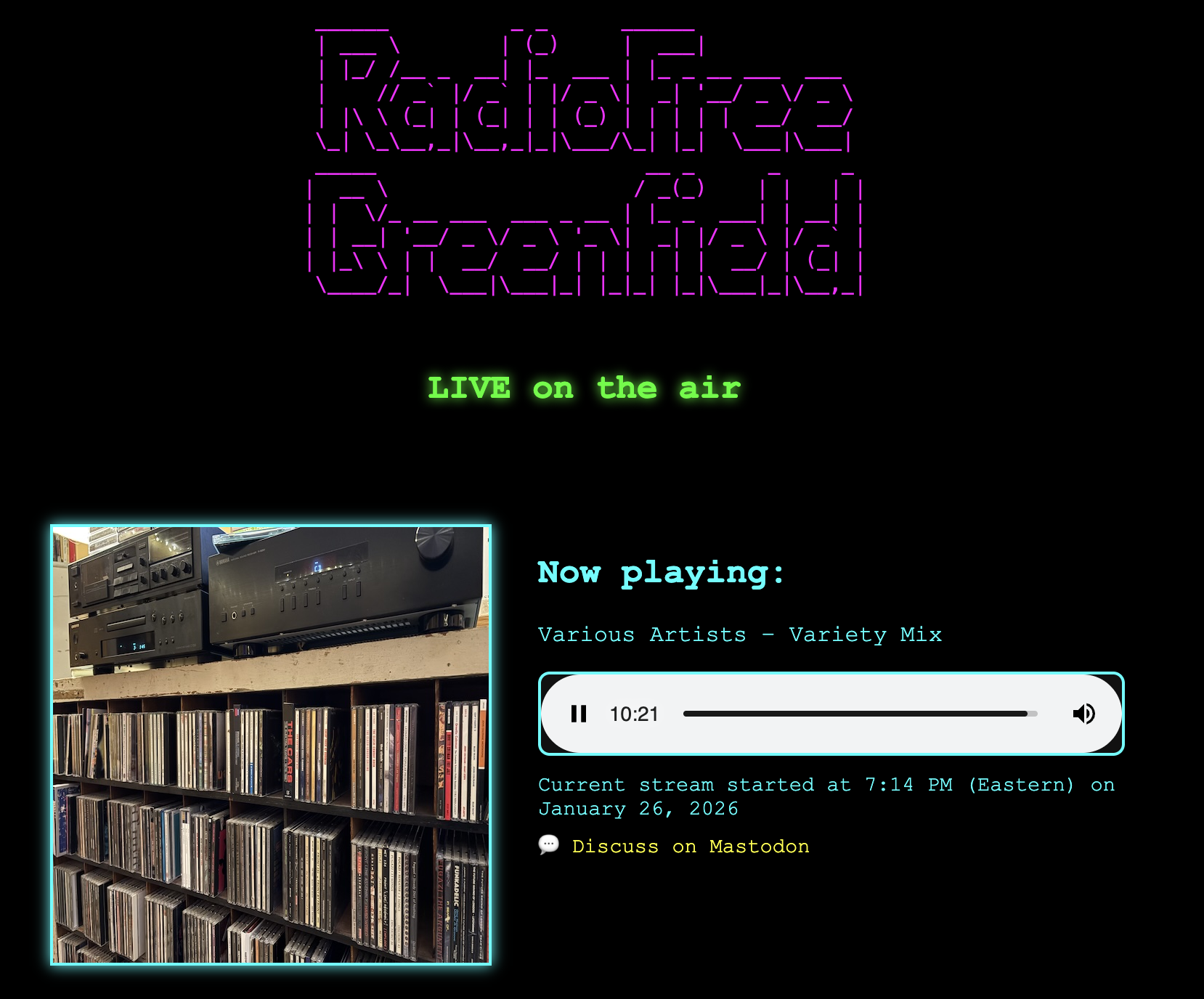
Adding variety mix streams to Radio Free Greenfield

I spent a bunch of time this past weekend working on my Radio Free Greenfield site. Now that I’ve got my album-ripping workflow back up and running and moved the storage to a bit more reliable piece of hardware, I decided to take on a project I had been thinking about since mid-summer.

The main focus of the site/service has been (and remains) listening to full albums. I don’t want to get into arguments about the purity of the album as a format; it is my preference and albums constitute the vast majority of my music listening, but I am fully aware that is because albums are what I grew up with. If you have followed me for any amount of time, you have probably heard me say that different people can like different things and that’s okay. If singles, EPs, or playlists are your bag, that’s cool and I don’t think you’re a bad person for it.

But I still prefer albums, and Radio Free Greenfield is my station and albums are mostly what I play on it.

Still, it’s not bad to change things up sometimes, right? With that in mind, I found myself thinking some months back that maybe I should see about occasionally streaming a mix of individual tracks. Seems straightforward; something any streaming tool can do. The challenge is that, because of the album-oriented nature of my station, I rip each CD to a single FLAC file, with a  directory structure that has a directory per artist, with subdirectories per album within artist, and I was really not interested in also having additional files per track.

“But,” I said to myself in a flash of brilliance, “Every album FLAC is accompanied by a .flac.cue text file that lists the individula tracks on the album, their titles, and their start times! Could I not use those .cue files to generate playlists of songs pulled from the full album files?”

What then ensued was several days’ worth of fiddling with shell scripts and queueing and all sorts of ffmpeg and Icecast fiddling, everying single bit of which resulted in stuttering, jumpy streams that skipped all over the place and were entirely unlistenable. And so I threw up my hands in a huff, reminding myself that I was really only interested in full-album streaming anyway, so I why was I even bothering with any of this?

Yesterday morning, though, flush off my success of moving all my files and fixing the CD-ripping workflow, I got to thinking about individual tracks again. Most of the problems I had the first time around seemed to stem from trying to do it all on the fly, so what if I parsed through all the .cue files at once, and stuffed the artist, album, and track info into a database, and then pulled from that?

So I gave it a shot, and unsurprisingly, it made the playlist generation part of the process much easier and more flexible. I started my first playlist stream, and it stalled after the first track finished and required a browser refresh to kick off the next track. No good! Turns out that even though my playlist streamer script was working and playing the next track on the list, Icecast was treating it as a new stream/session. On top of that, it took a very long time to even start the stream, as it was pre-rendering all tracks before starting.

The solution turned out to be two-fold: 1. Use a named pipe for the stream to hold the same Icecast session open (so that Icecast sees it as a single stream even though it was multiple tracks); and 2) Start the first track streaming as soon as it is rendered and then work on rendering the rest as they play. That solution fixed the stopping-after-each-track problem, and drastically reduced the amount of time between initiating a stream and having it actually start playing.

Those issues solved, I decided to keep things simple by having the playlist-streamer script stream to the same Icecast mount that the album-streamer uses. I don’t get updated track info or album covers in the Now Playing widget on the RFG homepage that way, but that’s fine. I dump the track listing into the Mastodon post for the stream, and that feels like enough to me.

There is a small bit of logic built into the playlist script—don’t pick multipe tracks from the same artist or album, keep track of what you’ve already played and don’t repeat, don’t follow a super-long track with a really short one—but otherwise, I have left it pretty random. I am thinking about maybe adding some mood or genre options, but for now, I kind of like just letting it go and see what comes up.

I do zero monitoring or tracking of stats, other than some basic tx/rx monitoring to keep an eye out for bandwidth problems. I don’t want to know what drives listeners; I don’t care. I hope people are enjoying it, but even if it’s just me, I like the idea of casting my music collection out into the ether.
Upgrading the Radio Free Greenfield enterprise-class data center

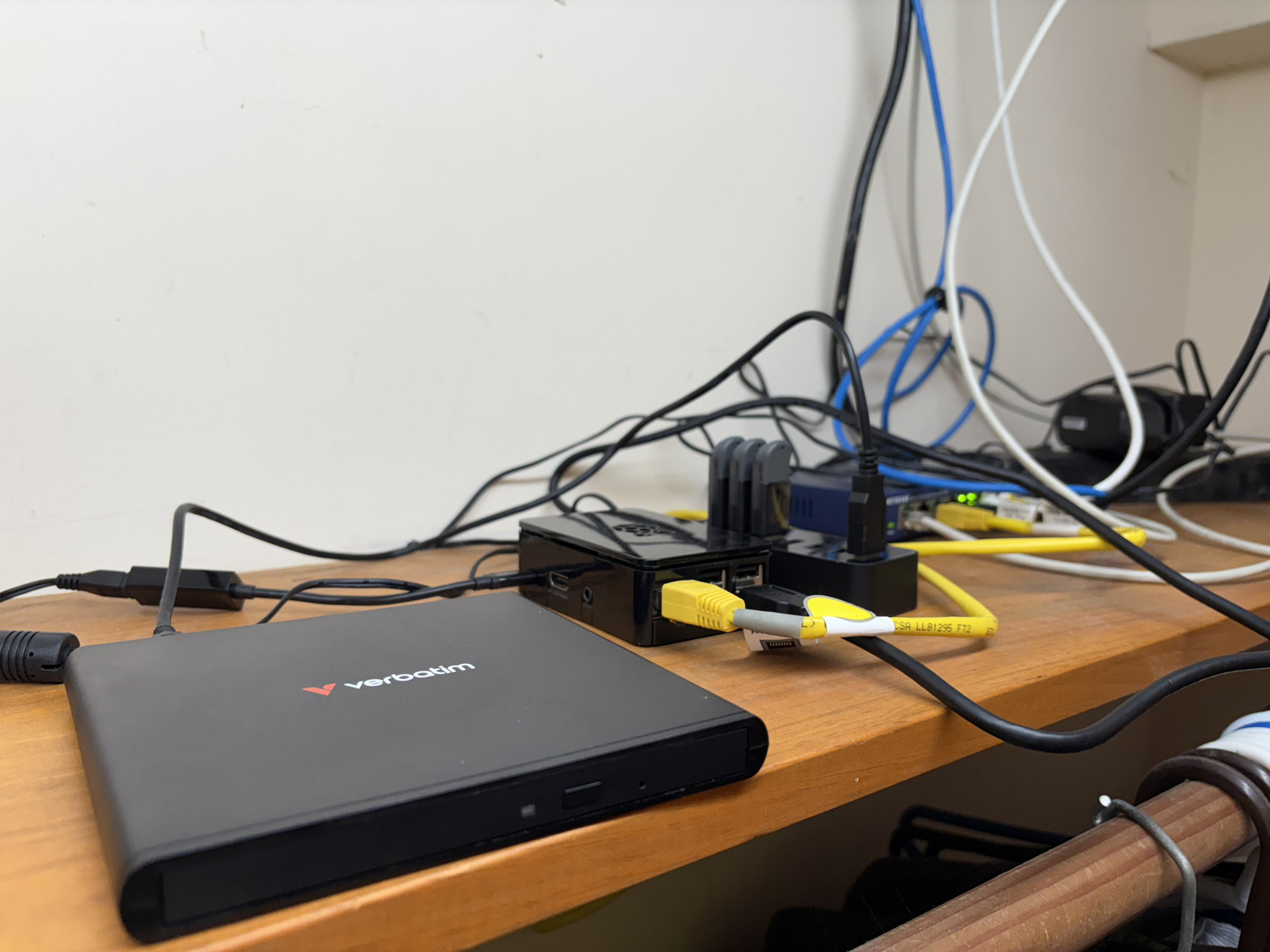
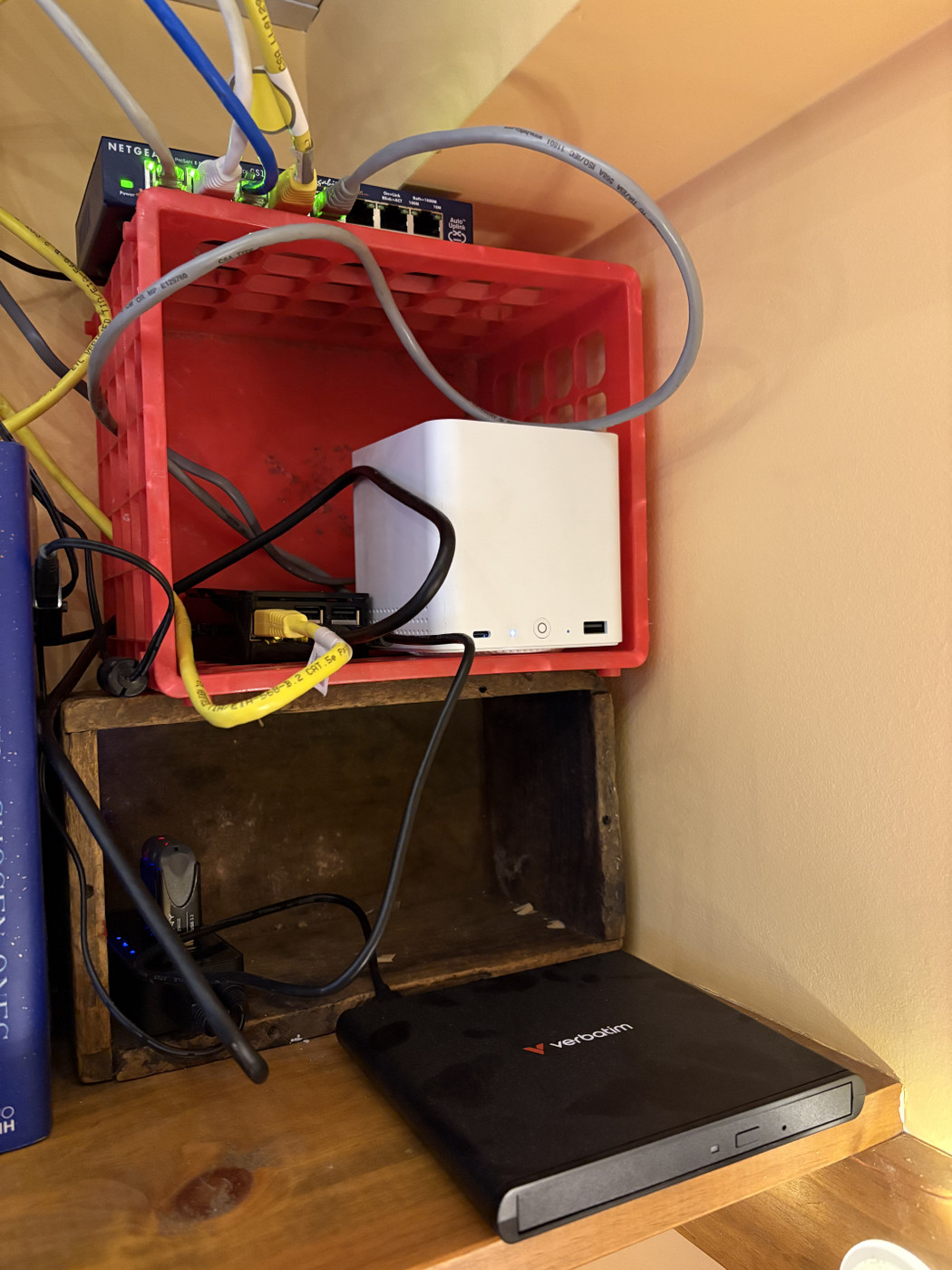
Fo my Radio Free Greenfield site, I have all of the albums sitting as full-album flac files on a storage array attached to the Raspberry Pi that runs the whole thing. It all basically works, but one thing that has been bothering me is that the term “storage array” is maybe overstating things a bit:

This so-called storage array is actually just three USB thumb drives plugged into a powered USB hub connected to the RPi. I used mergerfs on the RPi to turn those into a single volume. It’s not fast and it will fail the second I lose one of the thumb drives, but the whole thing ran me less than fifty bucks and took maybe twenty minutes to set up and configure.

Even so, I have been feeling increasingly nervous about this setup. I have very little interest in maintaining any sort of serious data on my home LAN (or even anywhere, really), so it’s not like I am keeping any important files or data here. But I have invested no small amount of time and energy in creating the flac files that live on this storage, and I would feel pretty bummed out if I lost it. That would also effectively shut down Radio Free Greenfield; not a huge loss to the world, but I would likely be a little sad about it.

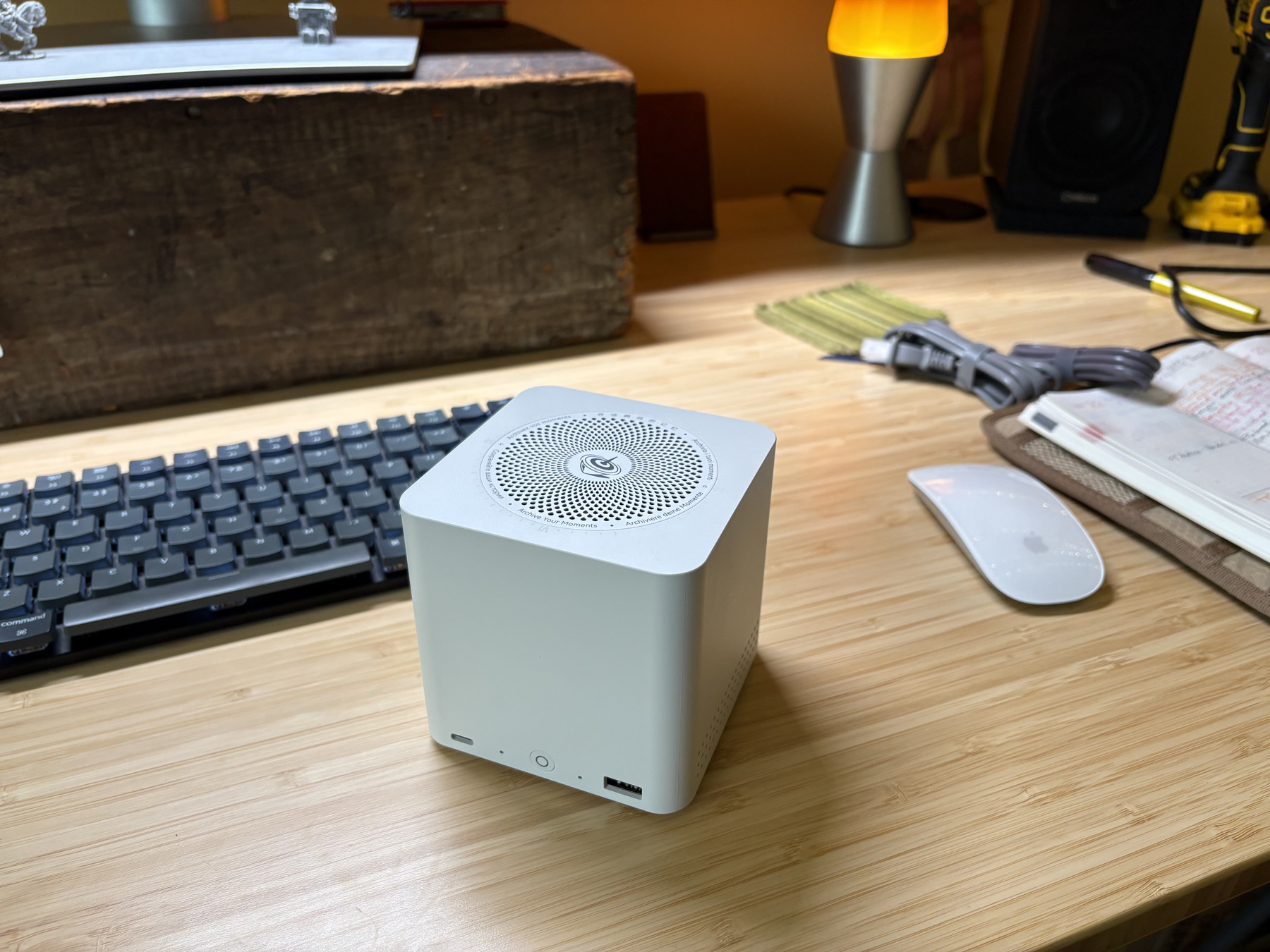
So with all of that in mind, I picked up one of these Beelink ME mini things. It’s an Intel N150-based low-power consumption PC with 6 SSD slots arranged around a big heatsink and fan. The one I got has only a single 2TB SSD presently, but it’s expandable up to 24TB. It is basically silent, generates relatively little heat, and fits in the palm of my hand.

It came with Windows 11 pre-installed, which I promptly erased and replaced with the community edition of TrueNAS. That was a quick and easy process, but getting the volumes and datasets configured once the NAS was up and running on my LAN was a bit more of a challenge. It’s not rocket science, but unless you’re a storage nerd (which I am definitely not), I would not say it is exactly straightforward. And the process is not helped by the fact that all of the blog posts and YouTubes about it are done by storage nerds who assume they are talking to other storage nerds.

Overall, it was an evening’s worth of work to get everything properly configured and accessible so that I could rsync all the flac files over to it and repoint the shell script that runs Radio Free Greenfield. In the process of doing that, I also took the opportunity to pull all a bunch of site-specific details out of the script itself and into a separate config file, and got the whole thing version-controlled and up on Codeberg, so that’s cool.

Anyway, the whole thing is operating properly now, with only a few minor hiccups along the way. With that done, I have been able to spend a bunch of time today getting my CD-ripping toolchain operational again. That, of course, required hours’ worth of fiddling with stuff that I couldn’t remember how I had originally set up, as well as a few links that had broken due to various version upgrades since I had to shut it down a few months ago while I was displaced from my office by basement renovation work.

Happily, it’s all fixed now, and I am busy adding new albums to the RFG library once more!


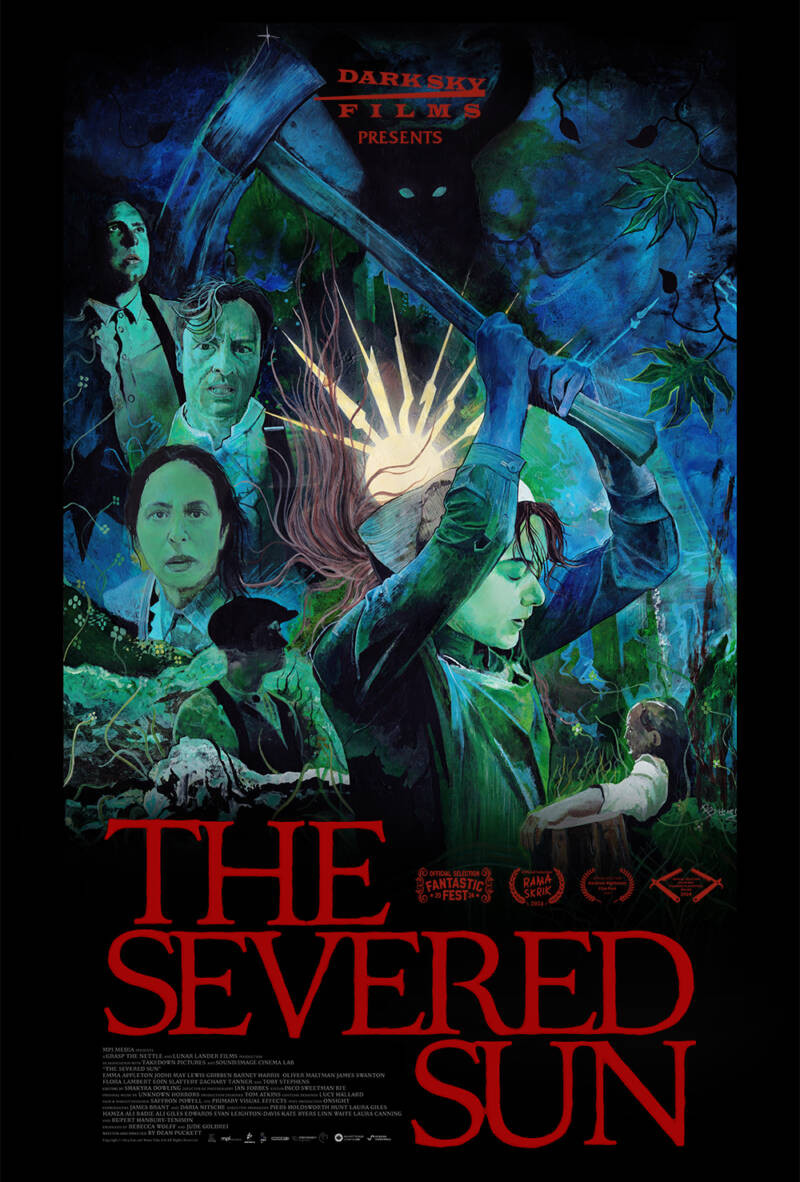
The Severed Sun (2024)

I watched The Severed Sun today. It’s a British movie from 2024 that appeared in Shudder this week. I’m not usually a big fan of the folk-horror genre but decided to give it a shot anyway because of the generally good reviews.

I was worried it was going to be yet another The Witch wannabe and while there are some strains of that, I’d say this one does a relatively good job of standing on its own. Sure, there’s a young woman with an oppressive home life who finds herself drawn to something creepy in the woods, but The Severed Sun finds ways to make that general story outline its own.

One thing I particularly like about this movie is how you are pretty much just dropped directly into the story and have to figure out characters and motivations as you go along. There is also a bit more to the setting than is initially apparent, and that lends some ongoing mystery and uncertainty to whole affair, but without beating you over the head about it.

All that said, The Severed Sun is not a super-deep or complex movie; in fact, I think it is a bit less so than the filmmakers would like us to believe. The characters, while not flat, are not particularly fleshed out, and if the movie were any longer, it would become pretty clear that the story is leaning on more than a few tropes to carry much of the load.

Even so, I enjoyed this movie. Emma Appleton does a great job as the main character Magpie, who lives in a weird religious community and—for several reasons that soon become clear—is feeling pretty done with it. Toby Stephens plays her father, who also happens to be the all-controlling leader of said weird religious community. Throw in an unnerving and creepy electronic score,  a lot of well-used handheld camerawork, and one of the more interesting designs for an antagonist (although, is it the antagonist? You decide!) that I have seen in a while, and it makes for a pretty engaging ninety minutes of understated horror.


FRAGILE, must be Italian

I feel like I can tell a lot about what sort of awful, over-demanding customer feedback a Discogs seller has gotten by how overpacked their shipments are.

This one was a CD wrapped in a plastic record sleeve and packing tape; that was taped inside two pieces of cardboard, which in turn was wrapped in several layers of bubble wrap and more packing tape. Then all of that was stuffed inside a custom-made cardboard box which was mummified with a bunch more packing tape and had an enormous FRAGILE HANDLE WITH CARE sticker that was three times the size of the shipping label and covered one entire side of the box.

I can only imagine that someone yelled at this poor shipper because a jewel case had a crack in it or a hinge was broken, and now they feel like they have to ship everything like this. I like for my stuff to get shipped safely, but so often I get this stuff and is packed like it’s crown jewels or something.

I don’t blame the seller; it’s not their fault. I think it is similar to how people have gotten used to ordering stuff and having it arrive that same day or the next. Who needs that? Most of the time, like the crazy packing jobs, it just isn’t necessary but now everyone expects it and demands it and leaves a bad review if sellers don’t do it.


Complicated things are complicated.

This meshtastic stuff seems pretty cool and interesting, but as with so much of this sort of thing, it is hard to know where to start.

The whole scene seems rife with HAM radio weirdos and prepper freaks. All of the “Getting started” videos I have tried to watch are like “Here are forty different options of things you have to just solder together and then 3D print the splorglehoop to connect with clomflinger to oscillate the trandimbulator at 487 dingleblarps. I’ve got a 27-videos series on that and I’ll link those in the show comments down below blah blah blah.”

I hate this kind of stuff. I get that complicated things are complicated, but I also feel like the people who make these videos are only talking to themselves.

It’s like trying a watch a tutorial to figure out some software tool and they’re immediately into how you just need to install some Docker image on your home lab and 37 terminal windows that you just script to using this library and all of these modules you can download from a repo that doesn’t exist anymore.