🌕 014 — What Is This?
Hi, hello, how are you? This is your friend Adam broadcasting to you from underneath the Snow Moon. You might notice that this issue looks just a tiny bit different. I’d been using the previous icon for a little while, but I’d started to notice that it had become de rigeur for AI agents to bear similar black-and-white, circular logos (see ChatGPT, Kagi Assistant, the new Siri logo etc) and so it’s time for a change. This new badge features the ideograph ⽊, one of the meanings of which is ‘wood’. I like its simplicity and it has the benefit of being a Unicode character (U+2F4A), which maximises usability. Do I have qualms about perceived cultural appropriation? I have qualms. Call me on it if you think I’m crossing a line.
• • •
It’s kinda neat that this issue falls on the first of a month. For one thing, I get to tell you about the calendar that I’ve been enjoying this year. It’s a ‘sculptural calendar’ by French artist Damien Poulain, with each day’s page featuring a unique composition of simple geometric forms in block colours. Here’s today’s page, in situ, hanging from a clip on my bedroom wall.
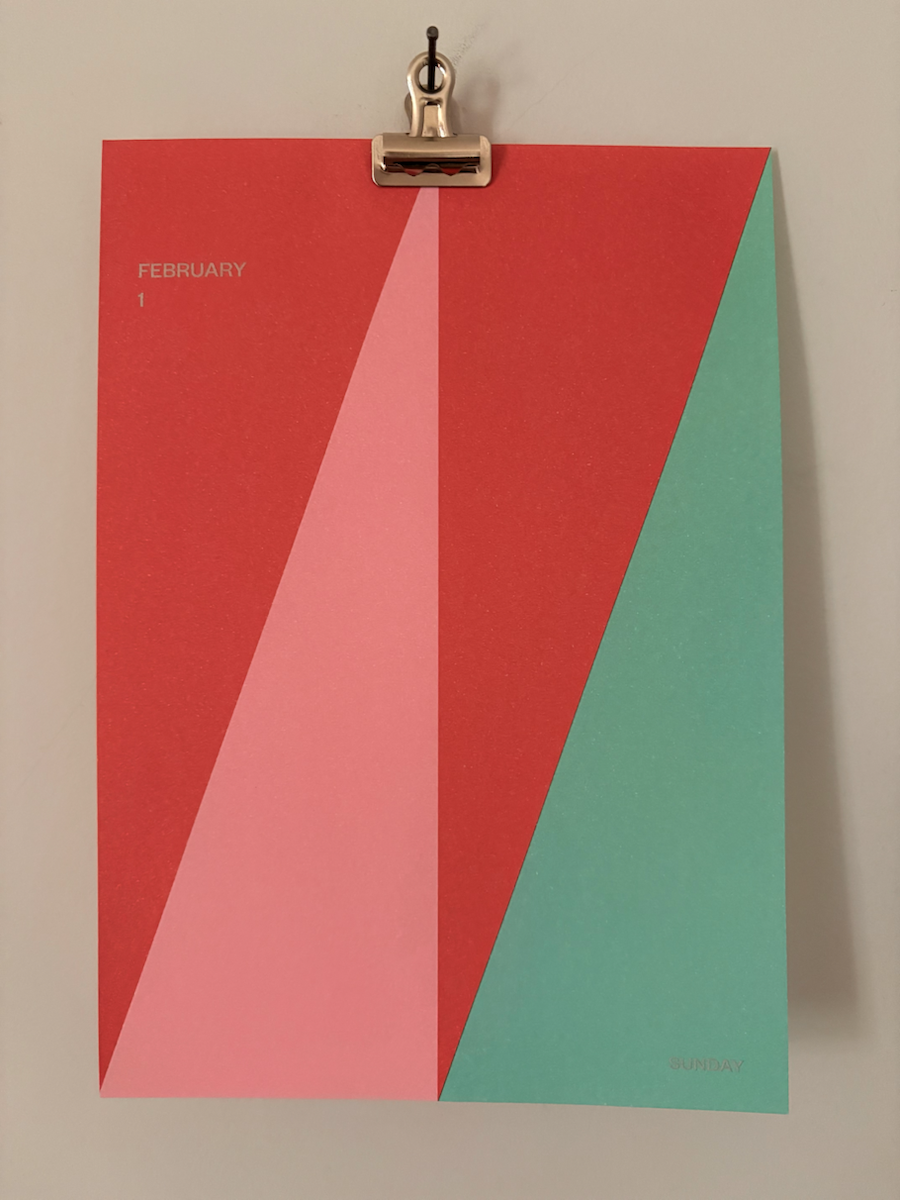
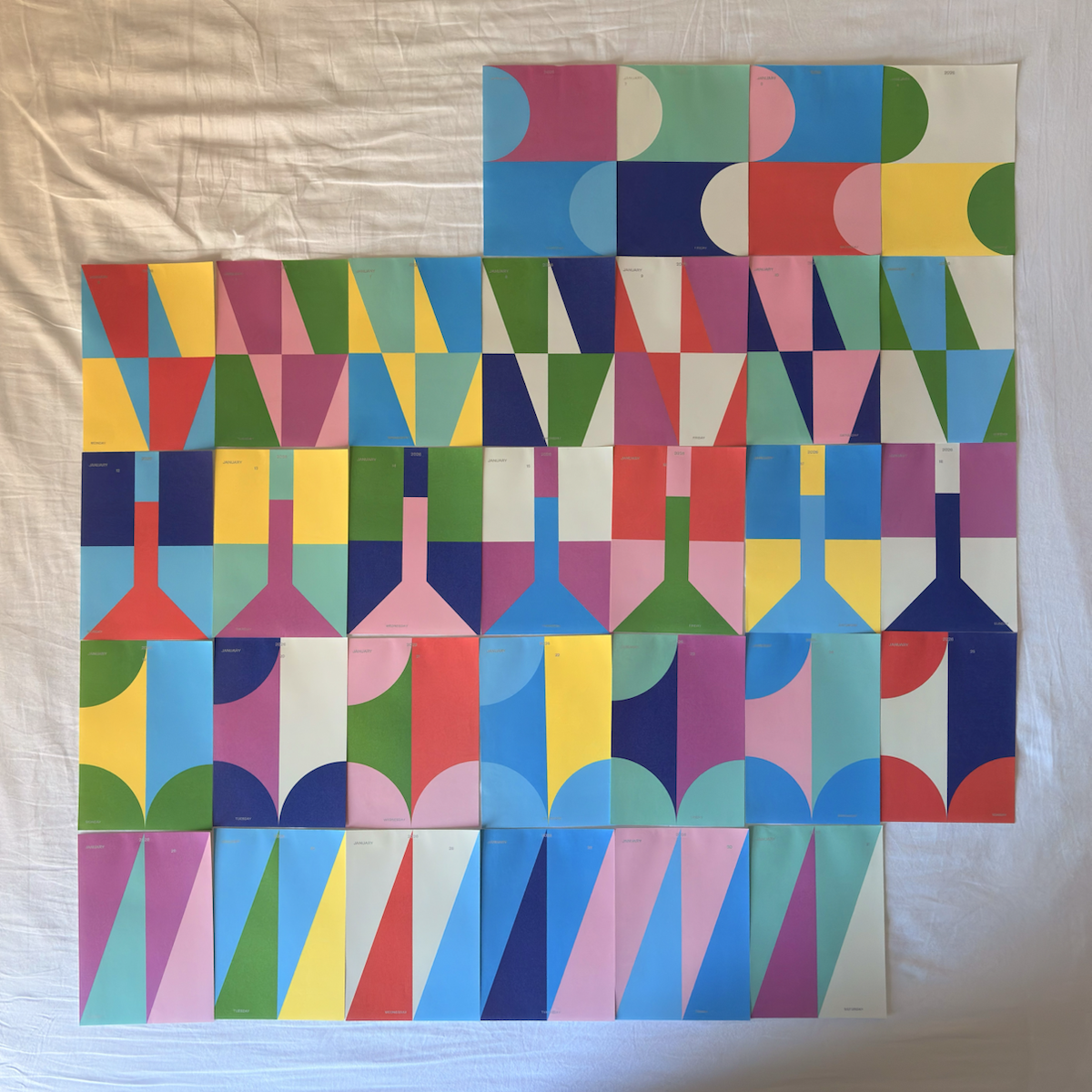
It’s become a fun part of my morning routine to see what the new day’s page looks like. And at a more macro level, there are rhythms to the days, weeks and months as they move across the pages from left to right. Here’s what January looks like when laid out in a grid.
• • •
A week or so ago, I gulped down Ariana Harwicz’s slim debut novel Die, My Love (2012) in advance of Lynne Ramsay’s film adaptation (Die My Love (2025), no comma) arriving on MUBI. It’s an arresting piece of fiction, both thematically and (in Sarah Moss and Carolina Orloff’s translation) textually.
I found particularly effective the manner in which Harwicz warps time and sensation on the page, so that it represents her protagonist’s state of mind and confused perception. It’s not a new technique of course, to shape a text through the lens of its narrator’s psyche, but here it’s done superbly well, to disorienting effect. In response to her feelings of resentment, boredom and entrapment within her relationship and her new motherhood, the nameless woman whose mind the reader shares throughout is by turns acidly cruel (‘The baby is crying his quota of morning torment.’ (p81)), and possessed of an inner monologue that twists and turns alongside her restless, malcontent spirit:
We saw the little rabbit skulls. And the death of a tiny chick that had got separated from its nest.
Its mother's sharp black beak, wide open in fear. I gave the baby swamp water from the pond to taste. Petals from the most colourful and fragrant flowers to eat. Leaves to chew on for their sap. We mimicked the calls of the animals around us, becoming part of them. The diurnal and nocturnal birds answered us, and we heard the cry that begins peacefully and turns mournful halfway through.
The pleasant vowel Aa that changes into the hoarse, fearsome consonant Och. The bird that calls out and becomes two birds: sane and insane, tame and murderous.
I dunked my son in the icy water and baptised him by mistake. May God forgive me. (p66)
It’s certainly not a comfortable read, but I found it to be a more effective exploration of some of the same themes touched upon in novels like Rachel Yoder’s Nightbitch (2021), all the more potent because it doesn’t veil itself in a magical-realist conceit.
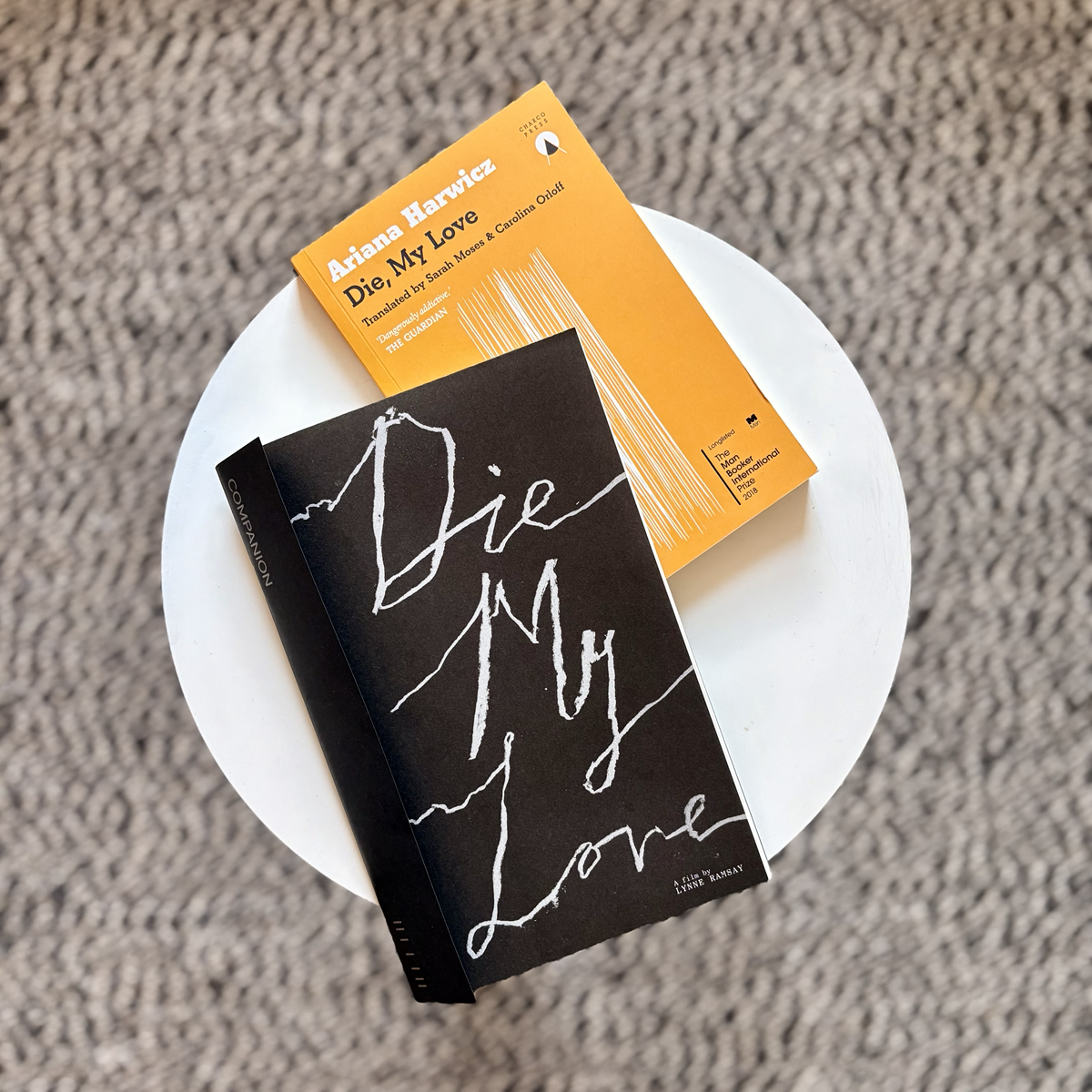
There are significant challenges inherent in bringing any first-person narrative to the screen. Despite cinema’s many strengths, it cannot compete with literature when it comes to giving the audience access to another consciousness. Lynne Ramsay has form here, having adapted Alan Warner’s experimental novel Morvern Callar (1995) into an award-winning film of the same title in 2002. I had also picked up a copy of MUBI Editions’ companion publication, featuring (as well as some neat illustrative design flourishes) essays written by actress Jennifer Lawrence, cinematographer Seamus McGarvey and Harwicz. The author is complimentary of Ramsay and Lawrence on exactly this point:
[The film] seems to unfold inside the head of her character. In this way, it is very similar to the novel, which is written in the first person.
The first person is a soliloquy, a solipsism.
You can never approximate the interiority of literature, but this film comes close, partly because of what Ramsay does with the sound, which offers us a passage into the interior.
Indeed, one of the most striking differences between novel and film is found in the character of the husband. When not completely absent from the text, he is little more than an object of his wife’s ire, more-or-less steamrolled by her increasing mania. On screen, Robert Pattinson attempts to present something of an opposing force to Lawrence, and even though it’s a futile effort, it necessarily changes the relationship dynamic. As part of her essay in the companion publication, Lawrence attributes this to the filmic version of the man being a representation of how her own character perceives him, further deepening the movie’s commitment to translating the text’s first-person nature.
The film is certainly a wonderful piece of work in its own right. If it has a shortcoming, it is owed to the decision to move it to the United States. An important part of the narrator’s struggle in the novel is that she is an outsider. The book is set in rural France, and the narrator is the only non-French character present. The cultural and linguistic barriers this presents are key to her sense of isolation. Where the house inhabited by Lawrence and Pattinson in the film is still remote, there is no sense of Lawrence’s character being ‘different’ to those around her in any readily-apparent way. This makes her increasingly strange behaviour more straightforwardly attributable to her devolving mental state, without her having an external reason for her feelings of loneliness and exclusion.
• • •
Some bullet points before I wrap up:
For this issue’s music pick, let me point you to a list I’m keeping of 2026 album releases that have hit for me (also available via feed my nerds);
I’ve been reading about the Nazi theft of church bells during WWII;
When I pick up a book with a cover I like, and flip to see who designed it, there are a few names I’m accustomed to seeing: Luke Bird, Na Kim and Gray318 to name three. Add to that list Stephen Brayda, whose work I was introduced to recently;
I don’t make a lot of phone calls, but I’m still tempted to get one of these;
The two books that got me into Buddhism were Western Buddhism (1997) by Kulananda and Buddhism Without Beliefs (1997) by Stephen Batchelor. This recent podcast interview with the latter author reminded me what an interesting thinker he is: This Question Can Change Your Life;
A further note on perfectionism, as discussed last issue—I enjoyed this article on how the mindset impacts classical music:
technical mastery is a means to an expressive end, not the goal
• • •
That’s quite enough from me for one lunar cycle. As always, if you’d like to keep up with goings-on between despatches, navigate over to zioibi.com at your convenience: recent posts include details of a new game we could both be playing, and my visit to a Wes Anderson exhibition. Either way, I will meet you back here in your inbox on 3 March. Until then, stay safe, stay warm and enjoy your annual re-watch of Groundhog Day (1993) tomorrow!
✌🏻
— Adam
Sign up to receive the newsletter miscellany on the day of each full moon: